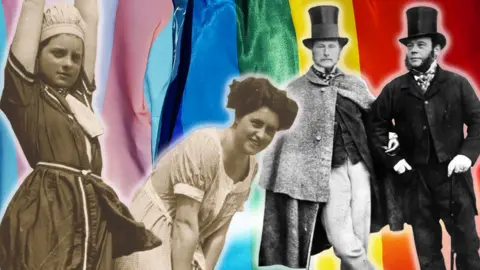
Most of us grew up learning history as neat, linear timelines full of kings, battles, and inventions. Rarely did textbooks acknowledge queer people or their contributions. If you are LGBTQ+, you may have noticed that absence. It suggested that queer lives were invisible or unimportant. However, queer people have always shaped society, often in ways that history conveniently ignored. Their impact reaches culture, politics, science, and social movements.
This omission is not accidental. History is written by those in power, which often meant erasing queer narratives. Fortunately, today we can uncover these stories. Doing so is more than just interesting. It validates identities, empowers individuals, and connects past struggles with present freedoms. Understanding queer history also shows how communities survived, resisted, and thrived even when society tried to silence them.
In this article, we will explore queer history that likely did not appear in school. From hidden heroes to cultural influence, these stories show that LGBTQ+ people have always mattered. Moreover, these histories provide lessons on resilience and creativity that remain relevant today.
Hidden Figures in Science, Arts, and Literature
Queer people have consistently contributed to culture and knowledge, even when their identities were hidden. For example, Alan Turing was a brilliant mathematician and cryptanalyst. His work helped break the Nazi Enigma code, which shortened World War II and saved countless lives.
Yet for years, textbooks celebrated victories without acknowledging Turing’s identity or the persecution he faced as a gay man. Therefore, remembering his story highlights how queer individuals have influenced history at great personal cost.
Art and literature offer further evidence. Writers like James Baldwin and Audre Lorde challenged social norms while celebrating queer identity. Unfortunately, they were often marginalized in mainstream curricula. In visual arts, Claude Cahun and Frida Kahlo expressed fluidity and defiance of gender conventions long before contemporary discussions of queer identity. In fact, acknowledging these figures shows that queer people were integral to culture, not exceptions.
Even in science and technology, queer innovators were often key drivers of progress. They worked in environments hostile to queer existence, yet their discoveries changed the world. Consequently, recognizing these individuals expands our understanding of history beyond heteronormative narratives. It affirms that queer lives have always intersected meaningfully with society.
Queer Activism Before Stonewall
Many people associate LGBTQ+ activism with the Stonewall riots of 1969. However, queer activism existed long before that. In early 20th-century Germany, the Scientific-Humanitarian Committee advocated for homosexual rights, campaigning against criminalization and promoting social understanding. Their efforts laid the groundwork for future global movements.
In the United States, activists like Marsha P. Johnson and Sylvia Rivera were organizing in the streets and in community centers before Stonewall. They fought for transgender rights, access to housing, and recognition within the broader gay rights movement. Furthermore, their work illustrates that activism is intersectional and multi-layered, not limited to one milestone event.
Even outside formal organizations, queer communities created informal networks of support. They organized underground salons, clubs, and safe houses where people could express themselves freely. Therefore, activism included not just protests, but also the cultivation of community and identity in the face of oppression.
Queer Contributions to Politics and Social Change
Queer people have influenced political movements in subtle yet profound ways. Harvey Milk, one of the first openly gay elected officials in the United States, demonstrated that visibility and political participation could spark social change. Moreover, Milk’s advocacy extended beyond LGBTQ+ rights, impacting broader communities in San Francisco.
Beyond individual politicians, queer activists contributed to civil rights, feminism, and labor organizing. Their perspectives enriched these movements by emphasizing inclusion and equity. As a result, their contributions challenge the misconception that queer issues are separate from wider societal struggles.
Globally, figures like Magnus Hirschfeld and Pauli Murray advanced legal and political reform. Hirschfeld’s work in Europe and Murray’s legal activism in the U.S. influenced laws and policies regarding sexuality and gender. In fact, these stories remind us that queer history is central to understanding societal evolution.
Everyday Queer Lives and Cultural Influence
Queer history is not only about famous figures or political milestones. Everyday lives also reveal resilience and creativity. Same-sex relationships, chosen families, and secret communities demonstrate the courage of queer people navigating restrictive societies. For instance, underground networks often provided support and emotional safety where official systems failed.
Cultural influence extends beyond private spaces. Queer communities historically shaped fashion, music, and language. Drag balls during the Harlem Renaissance and punk queercore scenes popularized styles and ideas that later reached mainstream culture. Consequently, queer contributions have had far-reaching social impact.
Learning about daily queer experiences humanizes history. These stories show that simply living authentically was a form of resistance. They remind us that history is not only the record of famous people, but also the lived experiences of everyday queer individuals.
Preserving and Learning from Queer History Today
Preserving queer history requires intentional effort. Much of it has been erased or ignored. Today, archives, oral histories, museums, and digital collections help document these stories for future generations. Additionally, education is crucial. Integrating queer history into schools validates identities and provides role models for LGBTQ+ youth.
Engaging personally with queer history strengthens community ties. Reading, visiting museums, or listening to oral histories connects us to past struggles and triumphs. In fact, these stories remind us that the fight for equality is ongoing and that learning from history empowers activism today.
Resources for Further Learning
1. LGBTQ+ Religious Archives Network (LGBTQ+ RAN)
A collection of archival materials documenting queer religious history and activism.
👉 https://www.lgbtqreligiousarchives.org/
2. The Lesbian Herstory Archives
One of the world’s largest collections of materials by and about lesbians and their communities.
👉 https://www.lesbianherstoryarchives.org/
3. GLBT Historical Society
San Francisco-based nonprofit preserving LGBTQ+ history, with exhibits, research collections, and public programs.
👉 https://www.glbthistory.org/
4. OutHistory
An online resource dedicated to documenting the lives and contributions of LGBTQ+ people throughout history.
👉 https://outhistory.org/
5. ONE Archives Foundation
A repository for LGBTQ+ history, offering research, education, and public exhibitions.
👉 https://onearchives.org/
Related Posts